

Hey all, it’s been a few weeks since my last update. Let me explain.
I had this inner awakening a month ago: no one would get me back to the vita contemplativa, the life of ideas, unless I took action for myself. So I revived this dormant Substack account and started writing ideas and memories—some that I’ve had for years, some that have just started to form. It was therapeutic yelling into the void.
Unexpectedly, the void whispered back. I picked up a few new subscribers (hello!) including two paid ones (hello?!) A few likes on my comments here and there. Enough to make me dare to think…maybe I should take this seriously. Which is to say, maybe I should take myself seriously, because after all these years in tech, I still see myself as a writer, a scholar, and a storyteller.
So I started working on a big idea about AI context vs. AI souls—more on that hopefully next week. And I started seeking community. Calling old friends, coworkers, fellow entrepreneurs, professional philosophers. A coalition of the contemplative, assembling a salon. And above all: finding likeminded spirits through reading.
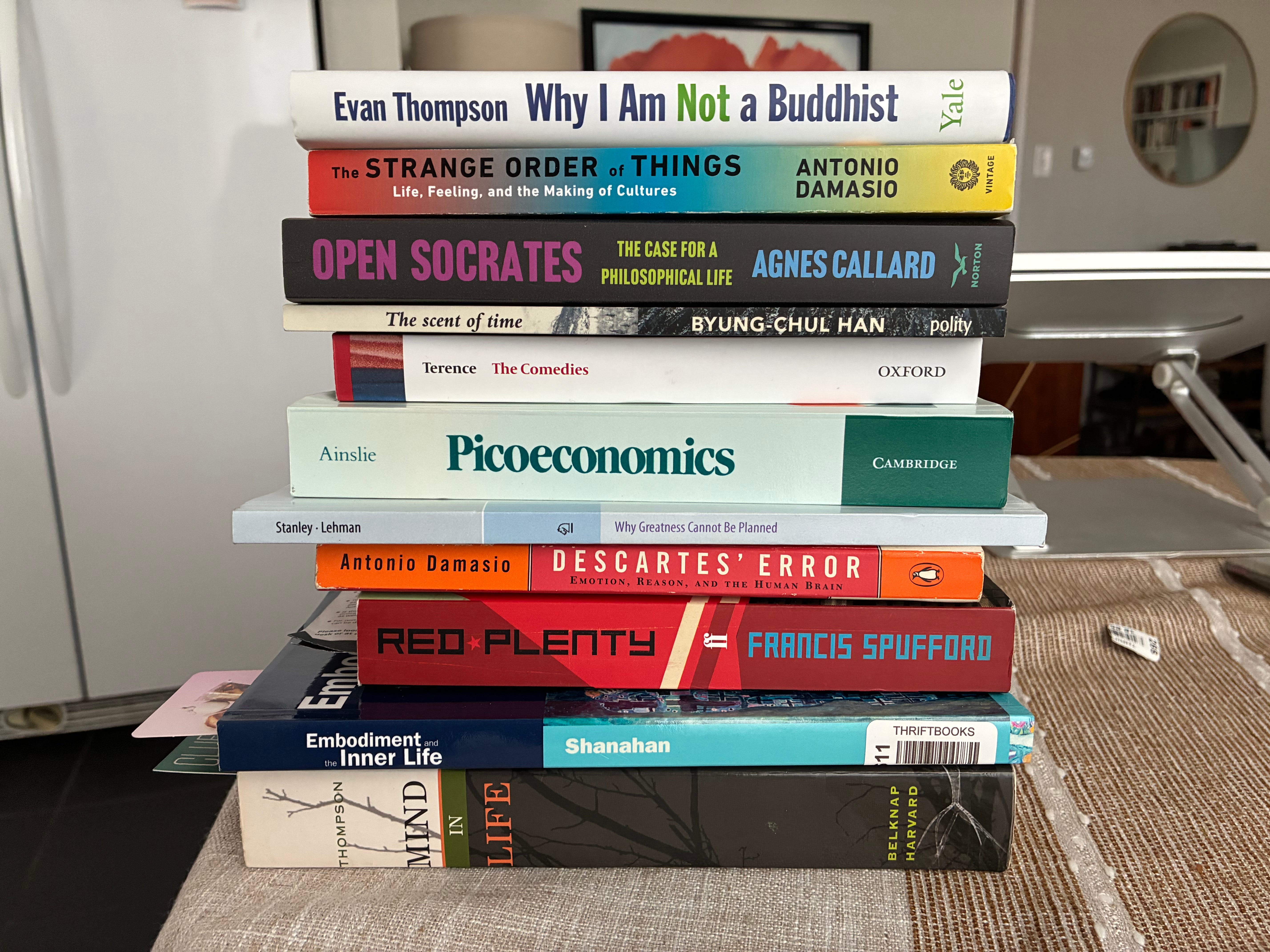
I started with Cosmos Institute’s list of summer reads for 2025, then I worked with Claude to add authors relevant to my current research. A friend or two recommended some more works. Finally, I added some books the good ol’ fashioned way: whatever popped up in Amazon’s “you may also like” suggestions.
Here are the books that I’ve started reading along with my current thoughts:
Red Plenty by Francis Spufford (2010)
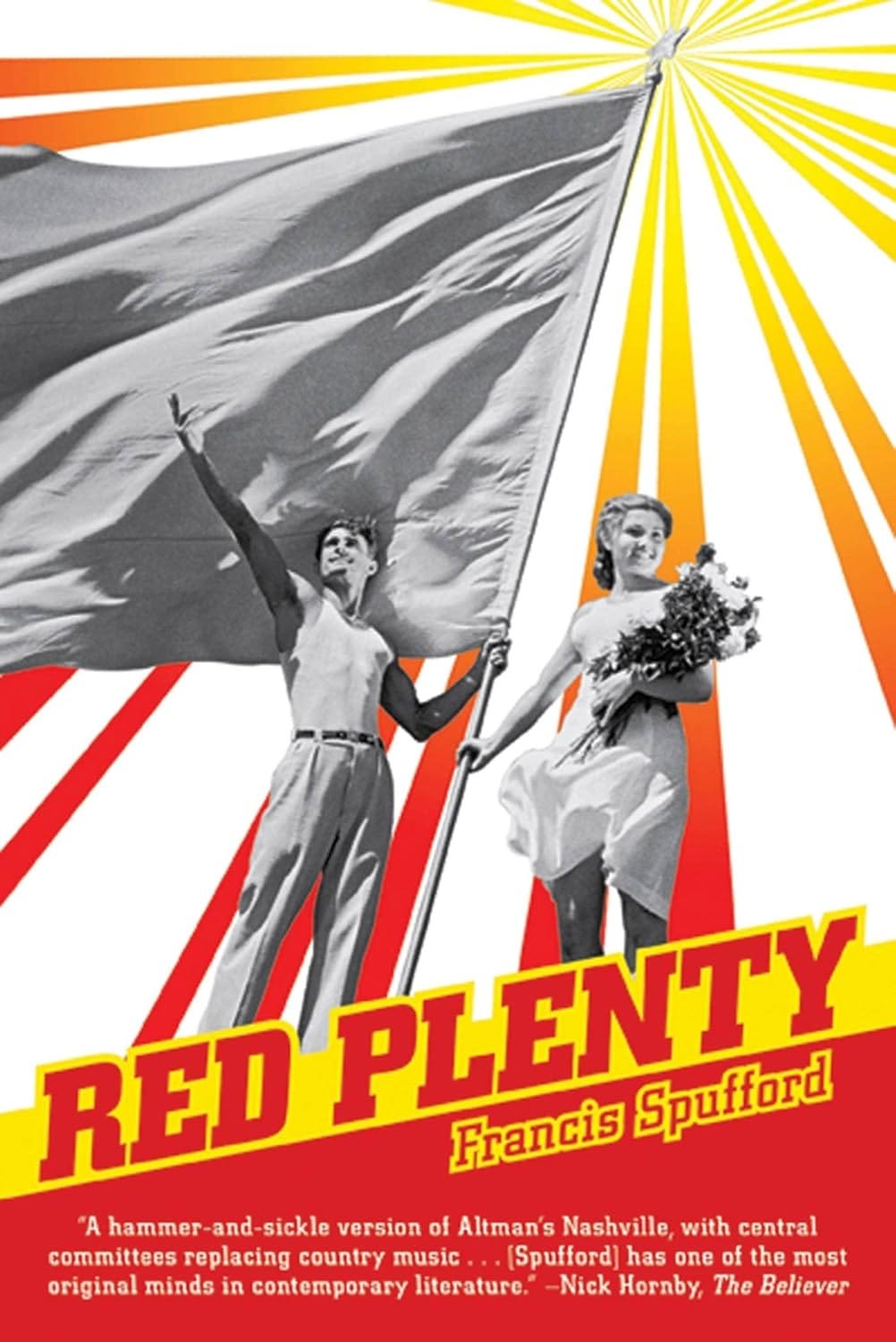
Some guys fall asleep to the soothing sights and sounds of World War 2 documentaries. My preferred hypnotic is YouTube videos about the inner workings of the Soviet economy.
This book—half fictional novel, half documentary history—is a tour de force explanation of what went wrong with the Soviet economic system, specifically the idea of reducing an entire economy to a rational, scientific, and planned basis. It has plenty of obscure details, almost pornographic in how much I salivate over them, about the mechanics of how individual individual sovnarkhoz would negotiate with state enterprises and Gosplan, the Union-level economic planning agency, to set prices and production quotas each year. But the book’s real genius is to reveal the gossamer linkages that bound those at the top, like Nikita Khruschev, to those nameless cogs, like the fictional tolkach Chekuskin, who made the system run.
AI has made it possible to reimagine the resurrection of the old Soviet cyberneticists’ dream, to control every aspect of an economy using technology to achieve perfect efficiency. Red Plenty’s overall message is that no matter how much technical progress we make, the success or failure of social engineering ultimately depends on what happens when ideals meet incentives and human nature.
The Strange Order of Things by Antonio Damasio (2018)
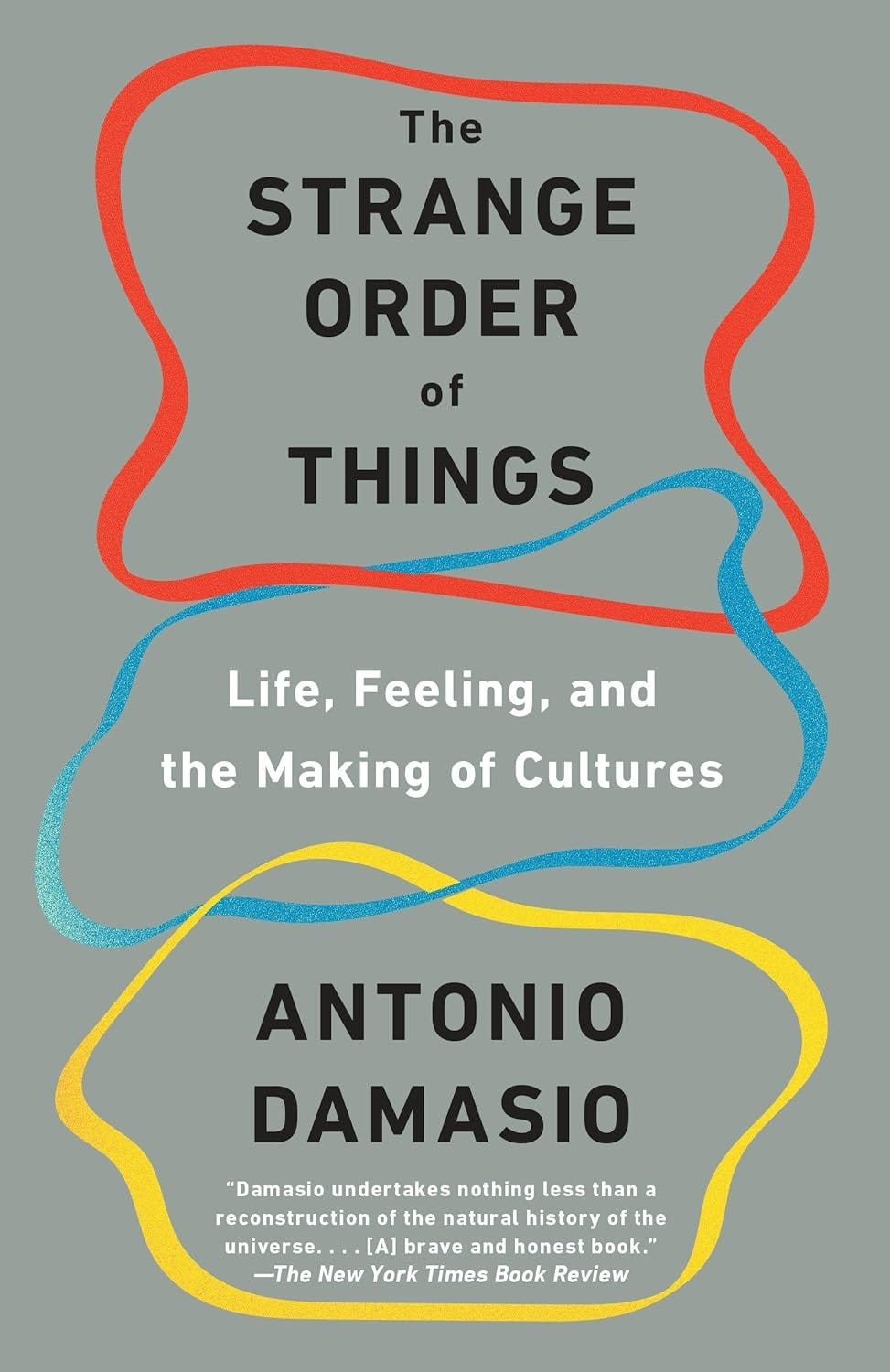
This one was recommended by Claude because it thinks that my nascent ideas about AI souls are very similar to what Damasio, who’s a prominent neurobiologist at USC, has to say about consciousness.
Damasio’s main argument is that consciousness arises from the creation of internal images within our brains, a development that’s strictly tied to the evolution of central nervous systems. The original evolutionary impulse for consciousness, he argues, is homeostasis, the self-regulating and up-regulating process that pushes organisms to higher levels of wellness.
I’m about a third of the way through and it’s a tough read. Damasio writes like a deconstructionist French philosopher, making assertions without any proof first then following with evidence rather than using evidence to build toward cautious suppositions. I really dislike this style of writing, it’s like constantly being taken prisoner and then released, over and over.
But I think the ideas are valuable and pose an interesting question: if consciousness is inherently embodied, can AI ever reach human levels of intelligence? Or at least, that’s the way the AGI/ASI question is usually framed. It’s clear to most observers that we’re moving past the notion that “human” intelligence is the yardstick for AI, but only because most presume that AI’s potential is so infinitely beyond human capabilities.
In contrast, the work of Damasio and others such as Peter Godfrey-Smith in Metazoa suggests that the true difference between human and AI intelligence may be in quality instead of quantity. The real question becomes, if disembodied but highly intelligent AI can never achieve consciousness, are we willing to let go of consciousness as a hallmark of intelligence?

Other than those books, I’ve been working on planning a wedding (did I mention that I got engaged?), paying the bills with my Mercor gig, and tax season.
My personal goal is to keep reading and writing, and I’d like to start building some AI systems based on some of my own ideas and research. Working at a startup like Workshop Labs would be a dream, but most of these smaller startups are in the Bay Area and I’m out here in lonely Tucson. OpenAI and the other big labs have started posting remote jobs, I’ve been thinking about applying at least as a web developer, and I’ve been working on my portfolio.
But I’m also want to work on something more than just UIs—I want to get into the real marrow and pith of AI, to take my humanistic and engineering training and create something wildly beautiful. I’m looking for an intellectual home. If you know of one that could benefit from my experience, please let me know—I’m open to new experiences.
A big thank you to my new paid subscribers who have helped directly contribute to that dream. Your trust and interest mean everything to me.
Talk to you real soon!