


I’m fired up by Cosmos Institute’s call for philosopher-builders, technologists who build with philosophical rigor and intentionality. But do they know how to make philosophically-grounded tech projects work in the real world? Does anyone?
It’s a question that has plagued me for over 12 years, one that’s especially relevant to those of us philosopher-builders who dropped out of the system and went rogue. The type, like me, who quit successful early-stage startups that later IPO’d or left the Bay Area for backwaters because we saw that the emperor had no clothes—and we were brave enough to venture into the unknown.

We rogues have been thirsting for the Cosmos Institute’s clarion call, but we’ve been burned too many times by companies whose philosophical stances turned out to be recruiting pitches, or intellectually rigorous projects that floundered on the rocks of market rigor. So we’ve retreated from ourselves, successfully building others’ startups, saving others’ companies, and training others’ teams, making half-hearted attempts at our own projects that usually end in disillusionment.
The surface problem is motivation. All startup founders must believe in their mission, but philosopher-builder founders must additionally be convinced of their mission’s intellectual rigor, or what we might call its rootedness. “Save the world” does nothing for me. A specific theory of how to save the world also doesn’t move the needle. But if you explain what “saving” means and can explain the complex web of how you would define a “world” over dinner, then I might start getting interested.
Rooting your views purely within yourself is almost impossible: philosophy and engineering are social sports that need a community. If she doesn’t have anyone to talk to about philosophy, let alone build with, then the philosopher-builder sits at home sad. I think this is what the Cosmos Institute is solving for, but for rogues I believe that the problem is deeper than that.
Why rogues need a school of thought
I have a close friend, let’s call him Frank, who’s one of the most talented operators in the tech industry and who’s philosophically-minded like myself. Frank and I have deep conversations about everything from AI to Descartes, from Daoism to the origins of time multiple times per week. I cherish our conversations, and you could say that he and I form a small community of philosopher-builders who are having some of the conversations that the Cosmos Institute fosters.

At the same time, there’s an unbridgeable philosophical gap between us. Frank’s a die-hard techno-optimist who believes in Progress and that, even if the short-term is rocky, technical progress eventually leads to objectively better outcomes for humanity. I’m no pessimist, but something about Progress with a capital “P” makes me wince. Neither position is right or wrong; it’s a question of temperament and how our minds work.
In the long run, the world needs both perspectives. The issue is that Frank has institutional support for his views whereas rogues like myself don’t. Frank truly believes in the industry and what he’s doing, so he throws himself into his work, and he’s appropriately rewarded. A rogue philosopher-builder who rejects the industry’s worldview not only lacks its support, they lack a school of thought that motivates them.
A school of thought is a shared pattern of meta-thought informed by the same structure and response to the same structural problems. Having community is a necessary but insufficient condition. I wrote about what a school of thought looks like and how I rediscovered mine while reading my former teacher’s dissertation.

In my case, it was my teacher, Tom Dechand, who formed the school that I come from through a deeply influential two-year undergraduate seminar that he taught at Johns Hopkins in the 2000s. When I read his work—or the work of Zachary Gartenberg, who sat in the same seminar with me as an undergrad and who wrote a brilliant piece on learning for the Cosmos Institute—I see my own mind at work.
At the top level, I see my, Tom’s, and Zach’s shared interest in the structure of thought, our emphasis on close textual readings, and our deep care for humanity. On closer examination, I also hear echoes of the same conversations and methods we explored almost 20 years ago. Their projects and their goals are legible to me—meaning, I can see how they connect to my own intellectual roots. I can integrate, interact with, and build on them. I not only understand their arguments, I grok where they’re coming from and, to a certain extent, who they are.
Rogue philosopher-builders desperately need the legibility that a school of thought can provide because we’ve rejected the tech industry’s narratives. It’s not about rejecting ideas that are foreign to one’s tradition, it’s about having a coherent base for integration.
Frank gets the base for free—the tech industry provides it for him, and he integrates external ideas into his worldview. It works because the external ideas don’t threaten the market viability of his core views, nor does holding the tech industry’s views violate his own integrity. He’s a true believer.
Rogues are in the opposite position. By default, our core views don’t fit into the market. We face the uphill battle of integrating the industry’s incentive structure into ours while also building successful startups and keeping our self-respect. We know how to build—we do it all the time—but doing it for ourselves requires meeting a bar that no one can meet without some external support. Finding a school of thought that can lead rogues to market validation through philosophical inquiry is the way to make ourselves whole and come in from the cold.
How to create a school of thought
Organizations like the Cosmos Institute have an opportunity. But how do you make a school of thought beyond a community? This is a hard goal and I won’t pretend to have the whole answer.
There’s an element of pull that resists explanation. Somehow, all of us who attended Tom’s seminar came with similar interests and observations from different fields. Call it resonance, shared temperament, or luck—Tom created the conditions of something worth running into. Once we were in the door, he amplified that resonance by welcoming our interests, giving them space during discussions, and even incorporating them into the syllabus.
Part of it is being opinionated. Tom really believed in his research, and even when we disagreed with him, we still thought a lot about his ideas, which influenced our own. For the Cosmos Institute and any similar organizations, I don’t know if “being opinionated” would be a feature or a bug.
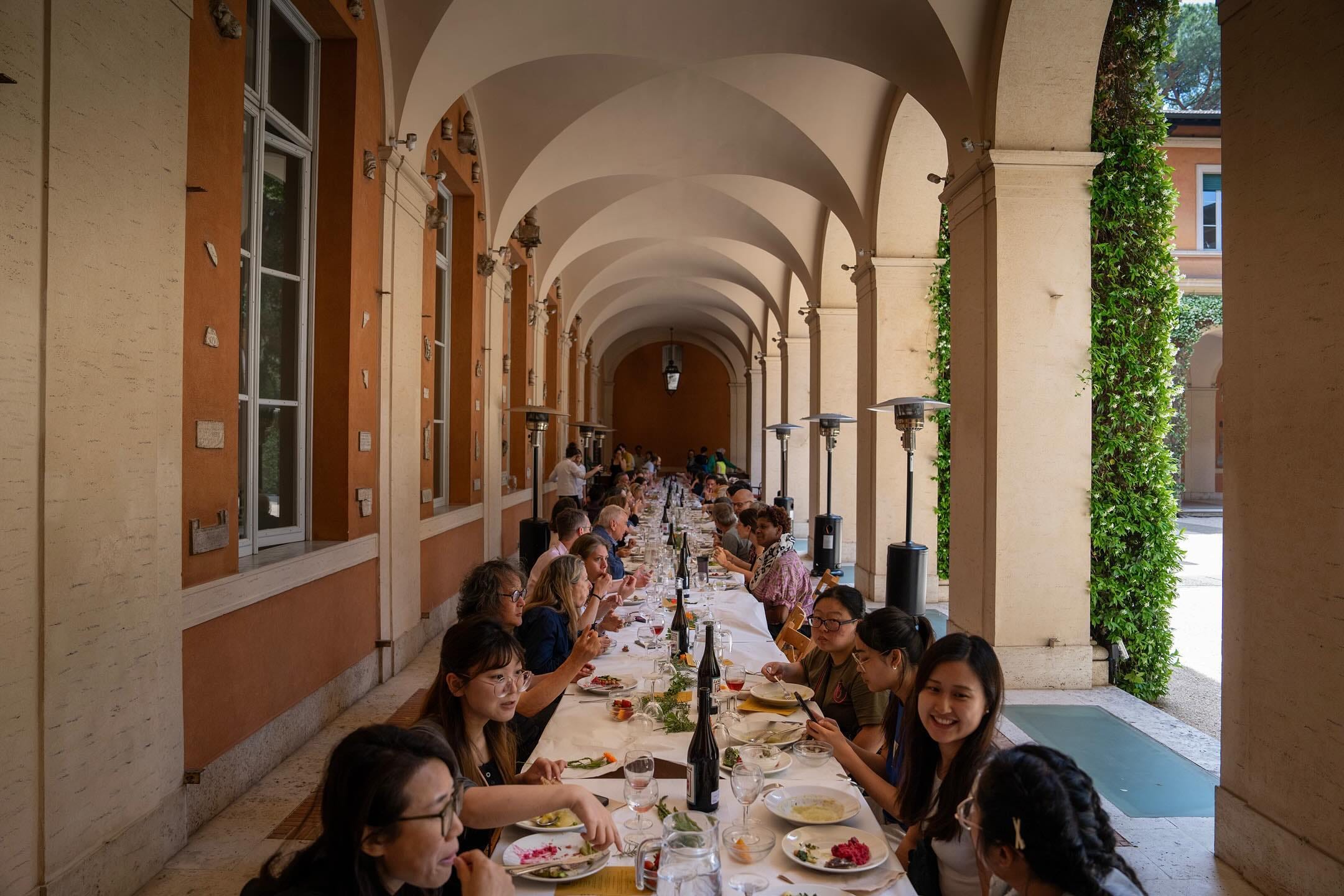
A lot of it is just putting in the personal work. Taking those walks with your colleagues. Eating dinner and breaking bread together. Tom did all those things. So did teachers like my former undergraduate advisor Christopher Celenza, one of the most passionate and involved professors I ever had, who literally broke bread with me when he was the director of the American Academy in Rome. No doubt a couple of my tech colleagues would have, if only I ever met them in person (the estrangement of remote work is yet another reason why rogues need a school of thought).
Why rogues matter
The stakes are high. If, despite their best intentions, Cosmos Institute and others only bring together philosophically-minded operators like Frank—perhaps because their social proof is so legible—then they will propagate the same values and thinking that repelled us rogues in the first place. It's the same worldview they're arguably seeking alternatives to. But if Cosmos and others can foster a school of thought similar to how Tom did—truthfully, they may be doing this already—then those of us who went rogue on philosophical grounds will find a home. Their mission, which I’m enamored with and wholly support, is too important and too worthy not to.

Rogue philosopher-builders aren’t operators at FAANG enterprises or elite academic institutions; but we could’ve been. We don’t have well-funded departments where we can A/B test our hypotheses; instead, we deal with the nitty-gritty of small clients and uncertain distribution. If we start an enterprise and it fails, we don’t get reassigned, we work for a year without income and end up $60k in personal debt; but we try anyway.
We represent putting our money where our mouth is, and we’ve been waiting. The philosophical tech revolution needs us as much as we need it.